
Many companies have a website.
But only a few have a website that truly works for them.
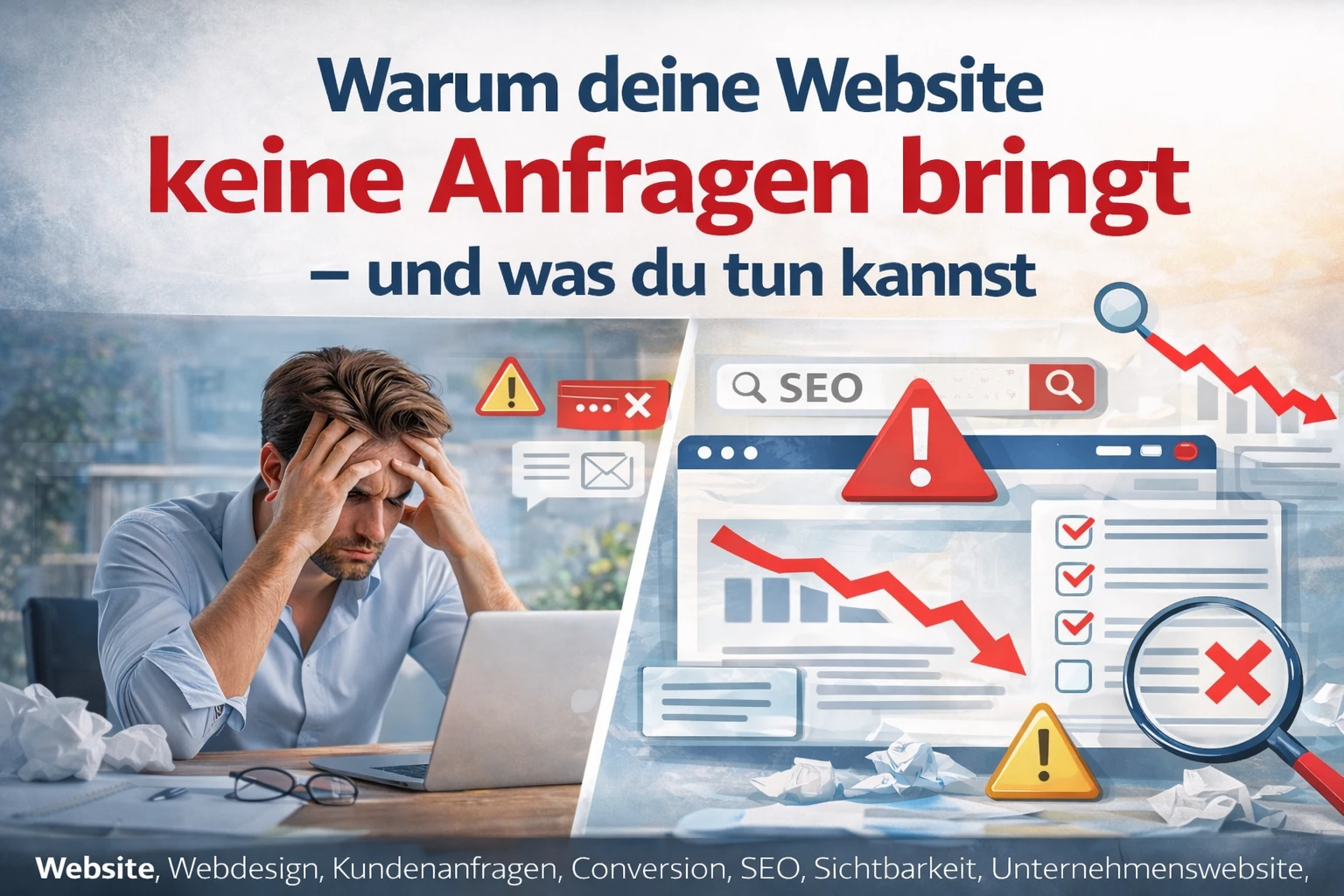
Perhaps your website looks tidy. Perhaps it has all the important information on it. And still, enquiries don't come in. No predictable leads. No clear impact. No reliable channel that brings in new customers.
That can be frustrating. Especially when you've already invested time, money, and energy into your online presence.
The good news is: In most cases, the problem isn’t that your offer is bad. It’s that some crucial levers on your website aren’t working together smoothly.
This is precisely where an honest appraisal is worthwhile. Because a good website should achieve more than just being present these days. It should make you visible, build trust, reduce effort, and enable qualified enquiries. This very combination of visibility, clarity, and reliable impact is also central to your positioning.
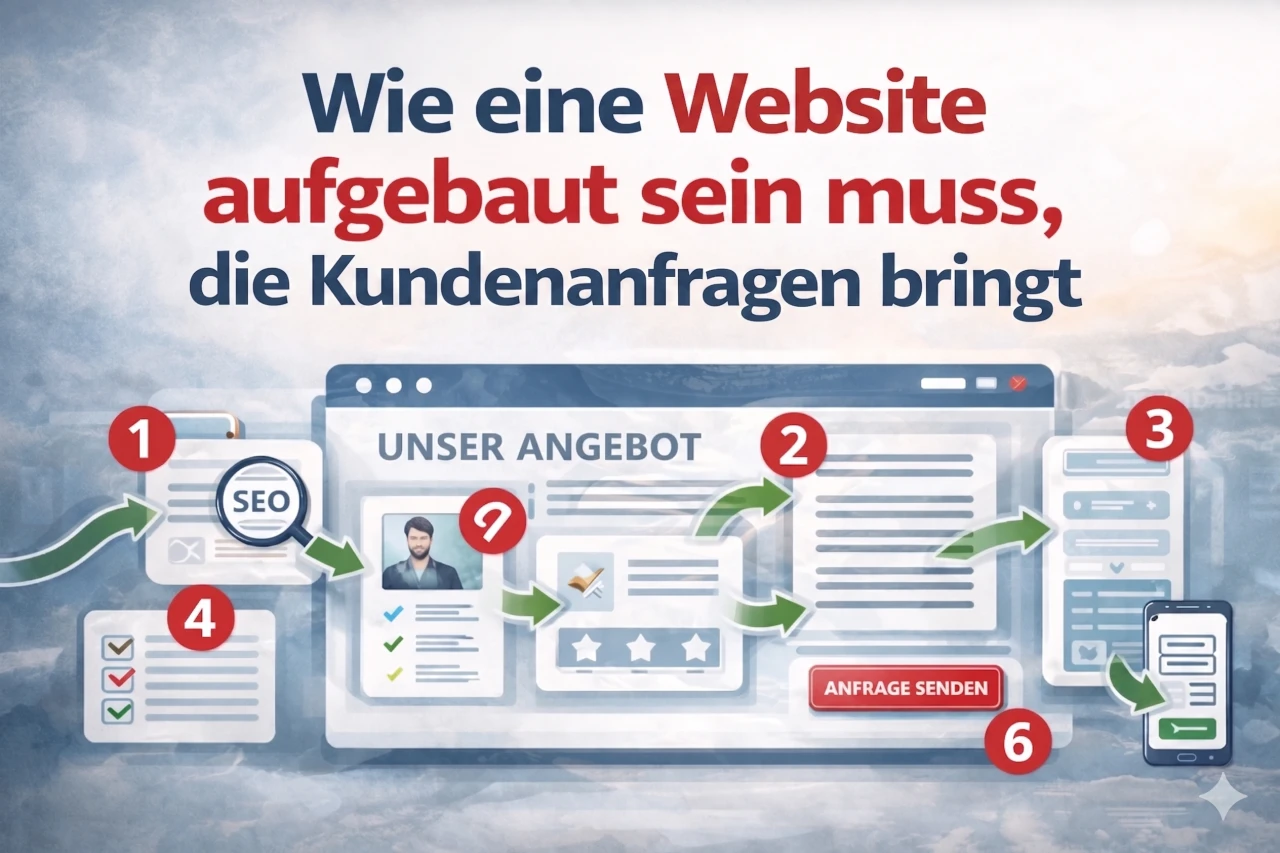
Your website isn't structured clearly enough.
Visitors decide in a few seconds whether to stay or click away.
When not immediately understandable,
- What you offer
- Who do you work for
- What specific benefit do you get from me
- and what the next step is
Uncertainty arises.
Many websites try to say too much in a short amount of time. They explain everything at once, jump between topics, or hide the actual core message. The result: the visitor has to sort it out for themselves. And precisely that almost never happens in everyday life.
A strong website leads.
She takes people by the hand.
She makes orientation easy.
When your website is clearly structured, you notice it immediately. Visitors understand what it's about more quickly. They feel more secure. And they are more likely to take action.
2. Your website doesn't build enough trust
People rarely buy a service.
You're buying security.
You buy clarity.
And they buy the good feeling of being with the right person or the right company.
That's exactly why it's not enough to just list achievements.
If on your website, for example, it is missing:
- a clear positioning
- a professional overall impression
- Understandable customer testimonials
- a quiet, high-quality language
- A recognisable attitude
then a residual doubt often remains.
And this residual doubt costs enquiries.
Especially with services, consultancy-intensive offerings and high-quality projects, trust isn't a „nice to have“. It's a conversion factor. Your brand comes in precisely here: with reliability, clear communication, and the feeling that you don't have to navigate the digital jungle alone.
3. Your website informs – but it doesn't activate
Many websites explain a lot, but they don't deliver.
The difference is crucial.
A website can have content and still not generate inquiries. Simply because it doesn't specifically guide visitors to the next step.
This often shows itself in typical places:
- unclear buttons
- Weak calls to action
- too many options at once
- Contact options are failing
- Important information is in the wrong place
A good website doesn't just answer questions.
She creates movement.
This doesn't mean selling aggressively. It means providing orientation to people. Whoever needs to make an inquiry must intuitively understand where they can click, why the next step is worthwhile, and what awaits them there.
4. Your visibility on Google is too weak
Even the best website is of little use if it's hardly found.
Many companies have a website, but no real SEO foundation. This means they lack the visibility needed to attract relevant visitors regularly.
Typical problems include:
- no clear keyword strategy
- Weak headings
- thin page content
- lack of local relevance
- Messy page structure
- no clean connection between content and search intent
This is particularly a shame because service providers, practices, coaches, and small businesses, in particular, can often be found much more easily with even modest improvements.
SEO is not an end in itself.
It's not about technology for technology's sake.
It's about the right people being able to find you in the first place.
And only then can your website showcase its true strength.
5. Technology and user experience hinder your effectiveness
A website can have good copy and still perform poorly.
Why?
Because technology and user experience directly influence how professional your offering is perceived.
If a page loads slowly, appears restless on mobile, forms are laggy, or content is difficult to read on a smartphone, then friction arises. And friction costs trust.
Visitors today expect as a matter of course:
- fast loading times
- Mobile optimisation
- Clear readability
- easy to use
- working contact channels
Technology doesn't have to impress.
It must function reliably.
And that's a huge relief factor for many companies: a website that runs stably, is intuitive to use, and doesn't constantly create new problems. This is also part of your brand promise: reduce effort, avoid hassle, implement reliably.
6. Your website is not actively working for your business
Many companies still treat their website like a digital business card.
That's too little.
A modern website can achieve significantly more today. It can not only display information but also support processes, pre-qualify trust, and even take work off your hands in your everyday life.
For example, by:
- Cleanly structured requests
- Appointment requests simplified
- Services clearly pre-filtered
- reduced frequent follow-up questions
- targets the right visitors more precisely
This is precisely where the difference between „being online“ and „being effective online“ arises.
A strategically built website doesn't just save time. It also improves the quality of enquiries. And it ensures your business appears calmer, clearer, and more professional digitally.
7. You talk too much about yourself – and not enough about customer benefits
Another common mistake: the website is written from the company's perspective, not the visitor's.
Then there's a lot about services, methods, tools and general statements – but too little about what the customer specifically gains.
People want to know:
- What's in it for me?
- Is my problem understood?
- Does that save me time?
- Does this help me attract customers?
- Can I rely on it?
The more clearly your website answers these questions, the more relevant it becomes.
The best language is not complicated, but clear. Not technical, but benefit-oriented. This exact style – empathetic, structured, strategic, and without technical jargon – is particularly important for your brand.
What you should do specifically now
Before you do everything again, you need one thing above all: clarity.
Ask yourself these questions honestly:
- Will a new visitor immediately understand what I offer?
- Is the benefit of my offer clear?
- Does my website look trustworthy and professional?
- Are there clear next steps?
- Will I be visible on Google for relevant search queries?
- Does my website work cleanly and quickly on mobile?
- Does my website actively support my business?
If you hesitate on several points, that's very likely where the greatest potential lies.
And that's precisely the good news: you don't have to rebuild everything at once. Often, the right decisions in key areas are enough.
Conclusion: No more content, but the right levers
If a website isn't generating customer enquiries, it's usually not because it lacks „even more text“ or „another sub-page“.
Clarity, structure, trust, visibility, and consistent user guidance are lacking.
A good website makes you visible.
A strong website builds trust.
A strategic website generates enquiries.
And that's precisely what it's about:
Not just being online, but being positioned digitally so that your website truly works for you.
Reliability isn't a promise – it's my standard.
If you want to find out where your website is currently missing out on potential, let's take a look together.
Your next step
Request your free website check now
and find out what is currently hindering your visibility, user guidance, and inquiries.